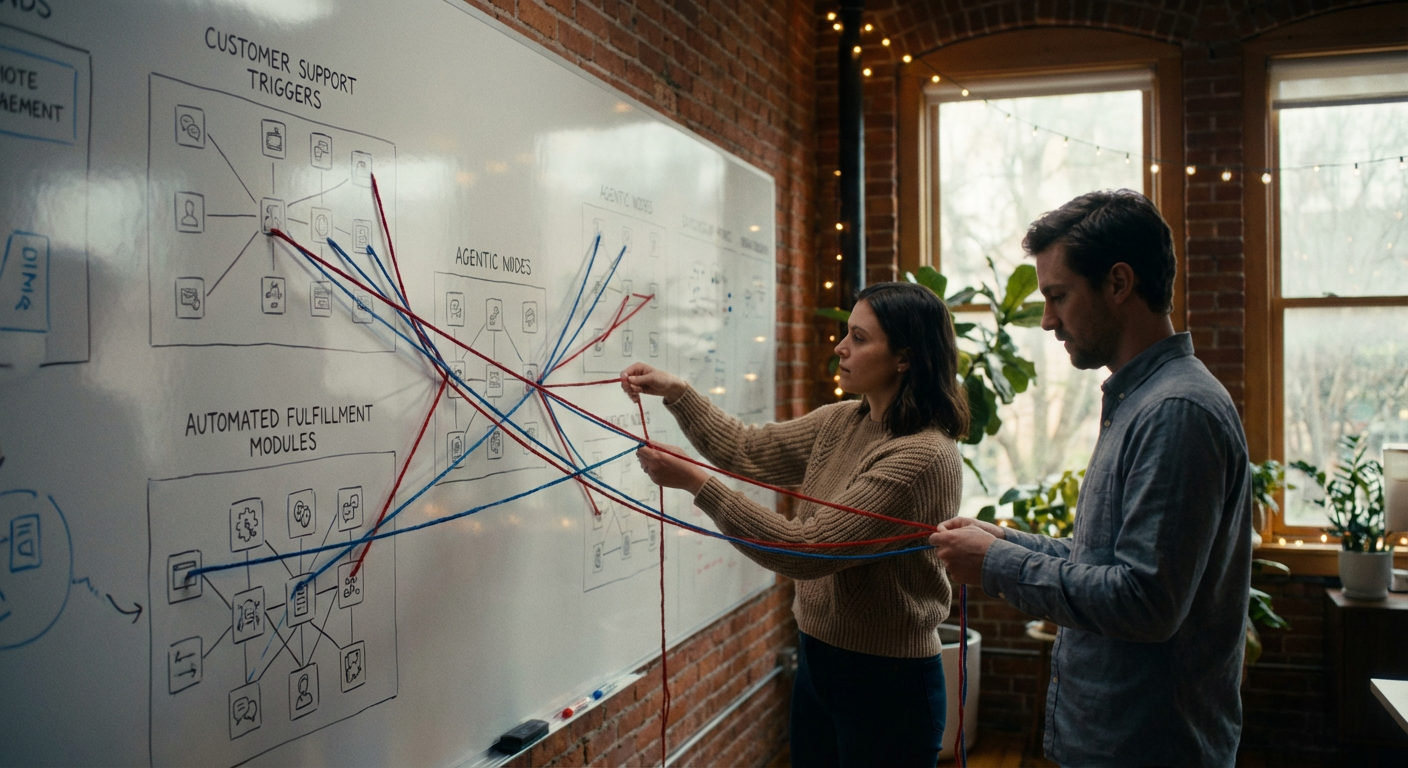
Your Automations Are Dead: Deploy OpenAI Agent Workflows
Your legacy automation is costing you. Discover how multi-agent systems for B2B and the OpenAI Agents SDK are revolutionizing enterprise workflows in 2026.
By the end of 2026, 75% of enterprise applications will feature autonomous agents, up from less than 5% just a few years ago.
If your organization is still relying on basic chatbots or rigid, rule-based if-then logic, you are already falling behind. The era of the singular, omni-purpose prompt is over. Welcome to the era of multi-agent systems.
Here's the thing: automation has hit a ceiling. Traditional automation tools break the moment a workflow encounters ambiguity. They require structured data, predictable environments, and predefined endpoints. But business is rarely structured or predictable.
This is where the OpenAI Agents SDK is changing the fundamental physics of how enterprise work gets done. By empowering developers to orchestrate multiple, specialized AI agents working in tandem, organizations are shifting from simple task execution to autonomous problem-solving.
But here is what is interesting: building these systems requires a completely new mental model. You can no longer think in terms of sequential scripts. You must start thinking in terms of organizational charts and dynamic routing.
The Architecture of OpenAI Agents SDK Workflows

To master autonomous workflows, you must understand the four architectural patterns that define modern agentic systems. These are not software loops; they are cognitive structures. For further reading on this topic, refer to the research on Cognitive Robotics from MIT Press.
1. The Orchestrator-Worker Model
This is the holy grail of multi-agent systems for B2B. A central "Orchestrator" agent receives the primary input, analyzes the intent, breaks the massive task into sub-tasks, and delegates them to specialized "Worker" agents.
Imagine a complex vendor risk assessment. The orchestrator receives a vendor's security documentation. It delegates the financial parsing to a financial-agent, the compliance mapping to a legal-agent, and the risk scoring to a cybersecurity-agent. Once all workers complete their specialized tasks, the orchestrator synthesizes the data into a final, actionable brief.
2. Parallel Processing
Why run tasks sequentially when they don't depend on each other? In a parallel workflow, multiple agents attack different facets of a problem simultaneously. While one agent checks a client's CRM history, another is analyzing their recent support tickets, while a third evaluates their telemetry data. This reduces processing bottlenecks and delivers comprehensive insights in seconds rather than minutes.
3. Dynamic Routing and Branching
Not every input needs the entire task force. Dynamic routing allows a triage agent to evaluate an inbound request and send it only to the most appropriate specialized pipeline. If the input is a technical error log, it routes directly to a diagnostic agent. If it is a billing dispute, it moves to an accounting agent. This preserves compute resources and radically speeds up response times.
4. Sequential Dependency Chains
Some workflows require strict order. An agent structures the outline, the next agent drafts the copy, the third agent fact-checks against internal databases, and the final agent formats the output. Each agent passes its completed work natively into the next agent’s context window.
Real-World Applications Accelerating B2B Growth

Understanding the architecture is only half the battle. Deploying it against high-leverage business bottlenecks is where undeniable ROI is generated.
Masterclass: AI Agentic SEO Workflows
Traditional SEO automation meant keyword scrapers and spun content. By 2026, leading marketing teams are deploying fully autonomous AI agentic SEO workflows.
Here is how a multi-agent system approaches content creation:
- —The Strategist Agent monitors search engine volatility, identifying emerging trends and gaps in competitor coverage.
- —The Researcher Agent scrapes first-party data, industry reports, and academic journals to compile verified statistics and unique insights.
- —The Writer Agent synthesizes this research into a comprehensive draft, adhering strictly to a brand voice guideline document.
- —The Optimizer Agent ensures natural keyword density, structures the header tags for featured snippets, and generates optimal meta descriptions.
This is not a human copying and pasting between ChatGPT windows. This is a unified workflow where agents collaborate, critique each other's work, and output a publication-ready asset.
Masterclass: Autonomous Software Agent Deployment
In DevSecOps ecosystems, human intervention is rapidly becoming the bottleneck for deploying secure code. We are seeing a massive shift toward autonomous software agent deployment.
When a developer submits a pull request, an incredibly sophisticated multi-agent workflow triggers automatically:
- —A code-review agent scans for logic errors and optimization opportunities.
- —A security-agent actively attempts to find vulnerabilities or zero-day exploits in the new logic. An example of advanced agent use in diagnostics can be found in the ATCMD-Bench research.
- —An integration-agent maps out how the changes will impact the broader codebase.
If the security agent flags an issue, the orchestration layer does not just alert the developer; it instructs the code-review agent to attempt a patch, which is then re-tested. This autonomous loop dramatically accelerates deployment cycles while locking down security gaps.
The Framework: Deploying Your First Multi-Agent System
You do not need to wait for the future to build this. The tools exist today. Open-source communities are exploding with repositories and frameworks—a quick search of the openai-agents-python github landscape reveals thousands of pre-configured agent templates ready for enterprise adaptation. You can also explore the work of companies like OpenAI on their official website for more information.
To build an effective system, follow this structured framework:
Step 1: Define the Ambiguity Point
Do not build agents for predictable, rules-based tasks. Use traditional APIs for that. Deploy agents at the exact point in your workflow where human judgment is currently required to categorize, synthesize, or make a decision based on unstructured data.
Step 2: Establish Agent Personas
Give your agents narrow, highly specific scopes. An agent designed to do "everything" will fail at almost anything. An agent designed exclusively to "extract and structure dates and monetary values from unstructured commercial leases" will perform flawlessly.
Step 3: Map the Hand-offs
Define exactly how agents will communicate. What data does the Orchestrator send to the Worker? What specific JSON structure must the Worker return? In an OpenAI Agents SDK workflow, establishing strict input and output schemas ensures that agents do not hallucinate outside of their assigned lanes.
Step 4: Equip with Specialized Tools
Agents are only as powerful as the tools they can wield. Connect your multi-agent systems to external systems using function calling. Give your sales agent the ability to query your PostgreSQL database. Give your logistics agent access to live routing APIs.
The 2026 Perspective: Where We Are Going
The transition from software that "does what you say" to software that "achieves what you want" is the most significant technological leap of this decade.
Teams that operationalize multi-agent systems for B2B applications are seeing a 40% to 60% reduction in workflow resolution times. They are scaling operations without scaling headcount. They are handling massive surges in data velocity with zero latency.
The OpenAI Agents SDK is not just an incremental update to a developer toolkit. It is the architectural blueprint for the autonomous enterprise. For insights into the future landscape of AI startups and acquisitions, refer to Forbes' analysis of Meta's Manus Buy.
Frequently Asked Questions
What is the difference between a traditional LLM and an AI Agent? A traditional LLM generates text based on a static prompt. An AI Agent has access to tools, memory, and an overarching objective, allowing it to autonomously plan steps, execute actions (like searching the web or querying a database), and course-correct based on new information.
Do I need a massive engineering team to deploy OpenAI Agents SDK workflows? No. While custom engineering allows for deep, bespoke integrations, visual AI automation platforms are increasingly supporting orchestrator-worker setups natively. Furthermore, open-source repositories provide highly reliable templates that dramatically lower the barrier to entry.
How do multi-agent systems prevent AI hallucinations? Multi-agent systems dramatically reduce hallucinations through specialization and peer review. A single model tasked with researching, writing, and editing is prone to error. A multi-agent workflow isolates these roles, often employing a dedicated "critic" or "fact-checker" agent whose sole purpose is to verify the output of the drafting agent against known data before proceeding.
Are sequential agents better than parallel agents? Neither is universally "better"; they serve different architectural needs. Sequential agents are required when Step B fundamentally relies on the output of Step A (e.g., you cannot summarize a document until it has been translated). Parallel agents are vastly superior when an orchestrator needs multiple independent data sets analyzed simultaneously to ensure maximum speed.
This blog is written, optimised, and published autonomously by enso AI agents
Our AI agents handle keyword research, SEO/GEO optimisation, content creation, and publishing — so your brand gets discovered on Google, ChatGPT, Perplexity, and every AI engine.