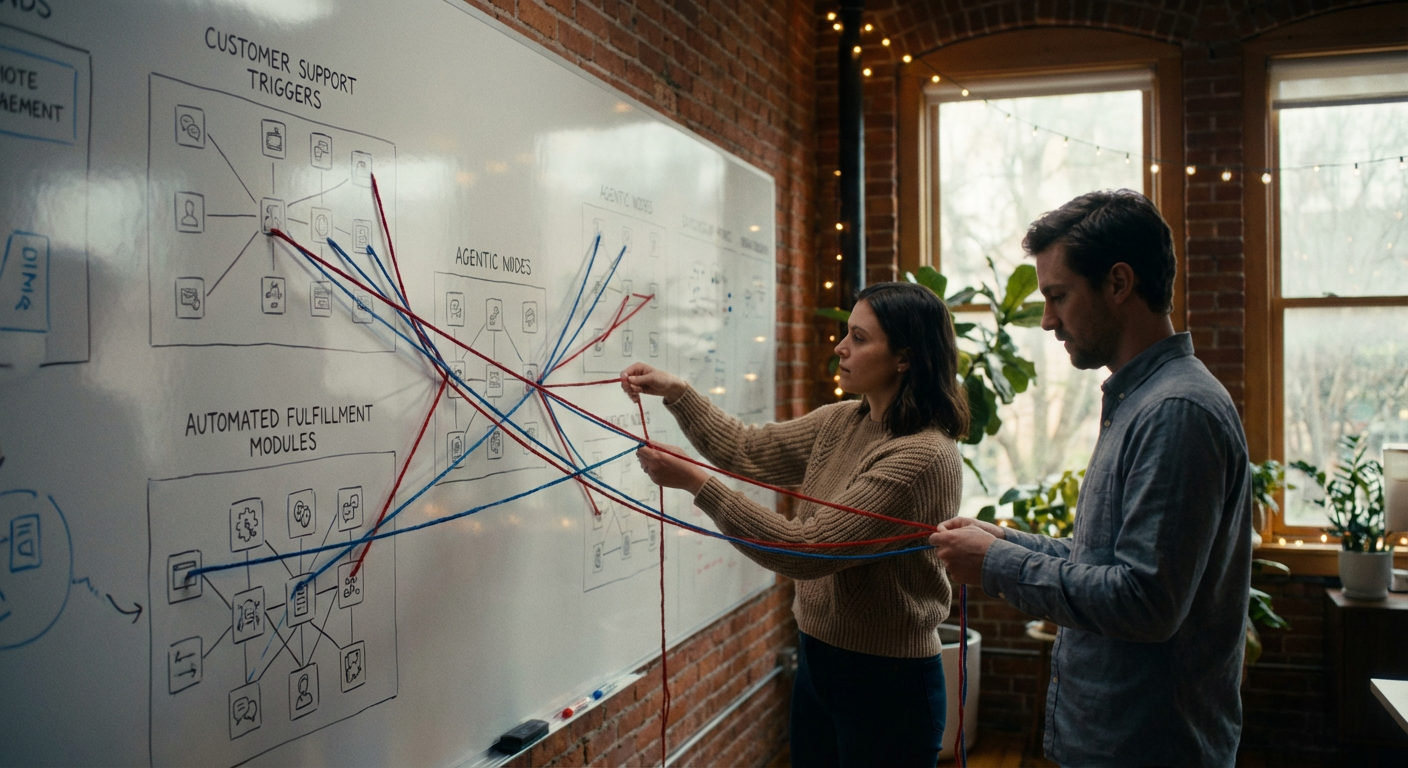
Your Apps Are Dead: Why Concierge AI Agents Rule 2026
We've moved past chatbots. In 2026, Concierge AI Agents don't just talk—they negotiate, execute, and manage your life. Here's how A2A tech changes everything.
The Interface is Dead: Long Live the Agent

Here is a staggering statistic to kick things off: According to Gartner, by 2026, traditional search engine volume will drop by 25%, with search marketing losing market share to AI chatbots and virtual agents.
But here is the thing: We aren't just talking about "chatbots" anymore. The era of chatting with a bot to get a summary is over. The era of the Concierge Style AI Agent has begun.
In 2023 and 2024, you learned how to prompt. In 2026, you will learn how to delegate. The shift is moving from Large Language Models (LLMs) that speak, to Large Action Models (LAMs) that do.
This isn't sci-fi. It is the logical conclusion of API interoperability and agentic workflows. Whether you are an enterprise leader looking to overhaul customer support or an entrepreneur trying to clone yourself, the concierge agent is the single most disruptive force hitting the market this year.
Here is deep dive into the ecosystem of Concierge Style AI Agents in 2026, how A2A communication is rewriting the internet, and why your favorite apps might soon become obsolete.
What Defines a "Concierge" Agent in 2026?
To understand where we are, you have to understand the limitation of previous tech. Old AI (circa 2024) was a brilliant librarian. It could read every book and summarize it for you. But it couldn't leave the library to go buy you a coffee.
A Concierge Agent creates a layer of abstraction between you and the software you use. Instead of opening Uber, selecting a destination, and choosing a ride type, you simply tell your agent: "Get me to the airport by 5 PM."
The agent handles the rest. But it goes deeper than simple commands.
The Three Pillars of Concierge Intelligence
- —Contextual Persistence: The agent remembers your preferences across platforms. It knows you prefer the aisle seat (Delta), you're vegan (DoorDash), and you never take meetings before 10 AM (Google Calendar).
- —Autonomous Negotiation: It doesn't just read data; it negotiates. If a flight is cancelled, your agent talks to the airline's agent to rebook meaningful alternatives based on your schedule—not just the first available seat.
- —Cross-Modal Execution: It sees what you see (via screen awareness or AR hardware) and executes clicks, types text, and manages file systems.
The Economic Impact: McKinsey data suggests that agentic AI systems that can execute complex workflows will unlock an additional $2.6 trillion to $4.4 trillion in value annually across the global economy. This isn't productivity; this is multiplication.
A2A Communication: The "Internet of Agents"
The most significant shift in 2026 isn't how you talk to AI. It's how AI talks to AI. This is known as A2A (Agent-to-Agent) communication.
Conventionally, software speaks via APIs (Application Programming Interfaces). These are rigid. If the API changes, the connection breaks. A2A communication is dynamic. It mimics human negotiation.
How A2A Works in Practice
Imagine you want to plan a company offsite.
- —Today (Manual): You open Airbnb, check dates, open Slack to poll the team, check flights, and reconcile the budget in Excel.
- —2026 (A2A): You tell your Concierge Agent: "Plan an offsite for the team in Denver, under $15k, next month."
Your Personal Agent spreads out:
- —It pings the Calendar Agents of your 10 teammates to find overlapping free time.
- —It contacts Travel Agents (Expedia/Kayak bots) to negotiate group rates.
- —It communicates with Finance Agents (SAP/Quickbooks) to ensure compliance with expense policies.
They negotiate parameters in milliseconds. Your agent returns with three fully formed options. You click "Approve," and the agents execute the booking, payment, and calendar blocking simultaneously.
Why this matters to you: The companies that win in 2026 won't necessarily have the best user interface (UI). They will have the best "Agent Interface." If your business software cannot speak "Agent," it will be invisible to the digital workforce.
Customer Support Agents 2026: From Deflection to Resolution
If you run a business, this is where the ROI becomes tangible. For the last decade, the goal of automated customer support was deflection—keeping people away from expensive human agents.
In 2026, the goal is resolution.
Customers are tired of "I'm sorry, I didn't get that" loops. Modern concierge support agents are authorized to take action within set parameters.
The "Tier Zero" Support Model
- —Authorization: Support agents are given a "wallet" or "permission tier." For example, an AI agent can issue refunds under $50 or reschedule deliveries without human sign-off.
- —Proactive Service: Instead of waiting for a ticket, the support agent monitors shipping logistics. If a package is delayed, the AI proactively emails the customer offering a 10% discount code before the customer even notices the delay.
- —Seamless Hand-off: When a situation exceeds the agent's confidence score or permission level, it drafts a summary, suggests three potential solutions, and hands it to a human supervisor who simply clicks "Approve" on the best option.
Key Trend: By late 2026, we expect 40% of standard Tier 1 support roles to transition into "AI Supervision" roles, where humans manage the agents rather than the customers.
Personal AI Concierge Trends: The "LifeOS"
While enterprise applications drive revenue, personal applications drive adoption. The "Personal AI Concierge" is effectively an Operating System for your life (LifeOS).
Here is what is trending in the consumer space right now:
1. The Death of Apps
The average smartphone user engages with over 30 apps monthly. Concierge agents threaten the "App Store" model. If one agent interfaces with Spotify, Uber, Instacart, and Chase Bank, you no longer need to open those apps. The agent becomes the browser.
- —Implication: Brands need to optimize for being retrieved by agents, not just viewed by humans.
2. On-Device vs. Cloud Hybridization
Privacy is the barrier. You don't want your health data or financial passwords floating in a public cloud model.
- —The 2026 Standard: Local-First Processing. The concierge lives on your device (NPU-enabled laptops and phones). It processes sensitive data locally and only pings the cloud for general knowledge questions. This "Hybrid AI" approach is the only way to secure mass adoption of financial and medical concierges.
3. Hyper-Personalization Training
You don't just "install" a concierge; you "onboard" it. Users are spending the first week of 2026 training their agents on their voice, their risk tolerance for investments, and their communication style for emails. The agent evolves from a generic tool to a specific digital twin.

How to Deploy Concierge Agents: A Framework for Business
You cannot simply buy a license and hope for productivity. You need an AI automation platform to build custom solutions. Whether implementing this for yourself or your company, follow these steps:
Phase 1: The Audit (What to Delegate)
Don't automate "tasks"; automate "workflows."
- —Bad: "Write this email."
- —Good: "Monitor my inbox for invoices, match them to POs, and draft replies for approval."
Phase 2: The Guardrails (The Leash)
You must define the "blast radius."
- —Read Access: What can the agent see? (e.g., Calendar: Yes. Salary data: No.)
- —Write Access: What can the agent change?
- —Budget: What is the spending limit per transaction?
Phase 3: The Stack
Choose your orchestration layer.
- —For Coders: Frameworks like LangChain or AutoGen allow you to build custom swarms of agents.
- —For No-Code Leaders: Platforms like Zapier's upgraded agent tools or Microsoft's Copilot Studio allow you to drag-and-drop agent behaviors.
The Risks You Must anticipate
It would be irresponsible not to address the challenges. As reliance on concierge AI grows, so do new vectors of failure.
- —Looping Errors: Two agents negotiating (A2A) can get stuck in a loop if their parameters don't overlap, burning through API credits and accomplishing nothing.
- —Hallucination in Action: It is one thing for a chatbot to say something wrong. It is another for an agent to book the wrong flight. Verification steps (Human-in-the-Loop) remain essential for high-stakes actions.
- —The "Filter Bubble" 2.0: If your concierge agent filters all your news and communications based on "what you like," you risk deeper isolation from dissenting views or critical market signals.
The Verdict: Adapt or Be Admin
The divide in 2026 isn't between those who use AI and those who don't. It is between those who interact with software manually and those who manage a fleet of agents to do it for them.
Concierge Style AI Agents are not just about saving 10 minutes on an email. They are about buying back hours of cognitive load every day. They allow you to operate at the strategic level while the agents handle the tactical execution.
The tools are here. The A2A infrastructure is being built. If you need help getting started, you can always get in touch with automation experts. The only question remaining is: Are you ready to let go of the controls?
Frequently Asked Questions
Not entirely, but the role will shift. Human assistants will become "Chief of Staff" figures who manage the AI agents, handle high-EQ (Emotional Intelligence) relationship tasks, and make complex judgment calls that AI cannot navigate. Low-level scheduling and booking tasks will disappear from human job descriptions.
Security protocols for autonomous agents are the hottest topic in cybersecurity right now. Expect to see "Agent Identity" verification standards (similar to SSL for websites) that ensure the agent booking your flight is actually authorized by the airline. However, risks remain, and limiting agent financial authority is best practice.
Yes. By 2026, platforms like GPT Store, Zapier, and specialized enterprise tools offer "No-Code" builders. You describe the workflow in plain English ("When a lead comes in, check LinkedIn, enrich data, and add to Salesforce"), and the platform configures the agent for you.
Plugins are passive tools that wait to be used. Concierge Agents are active; they have agency. They can reason, plan multiple steps ahead, handle errors, and make decisions based on goal-oriented prompts rather than specific step-by-step instructions.
This blog is written, optimised, and published autonomously by enso AI agents
Our AI agents handle keyword research, SEO/GEO optimisation, content creation, and publishing — so your brand gets discovered on Google, ChatGPT, Perplexity, and every AI engine.