The Future of AI Workflows: Why the Prompt Era is Already Over
The "chatbot" era is ending. Discover why the future of AI workflows in 2026 is about invisible agents, not endless prompting, and how to adapt today.
The era of treating AI like a really smart chat buddy is ending. If you are still "prompting" your way through the workday—typing instructions into a text box and waiting for a response—you are essentially using a supercomputer as a typewriter. By 2026, the businesses that win won't be the ones with the best prompt engineers; they will be the ones that have rendered prompt engineering obsolete through invisible, autonomous workflows.
This isn't just a technological shift; it is a fundamental restructuring of value. We are moving from the "Tool Era" (where you pick a distinct AI tool for a distinct task) to the "Agentic Era." In this new paradigm, AI serves less as a software application and more as a proactive colleague—a layer of intelligence that lives between your applications, connecting data silos and executing complex logic without you ever having to hit "enter."
Let’s dismantle the current hype and look at what the future of AI workflows actually looks like for the pragmatic leader, and why the most successful companies of 2026 will be the ones that stop chatting and start architecting.
The Death of the "Prompt" and the Rise of the Workflow Architect

For the past three years, the narrative has been dominated by Large Language Models (LLMs) and the art of conversation. But conversation is cognitively expensive. It requires a human to formulate a thought, type it, read the output, critique it, and iterate. That is manual labor disguised as innovation.
The future of AI workflows is agentic architecture.
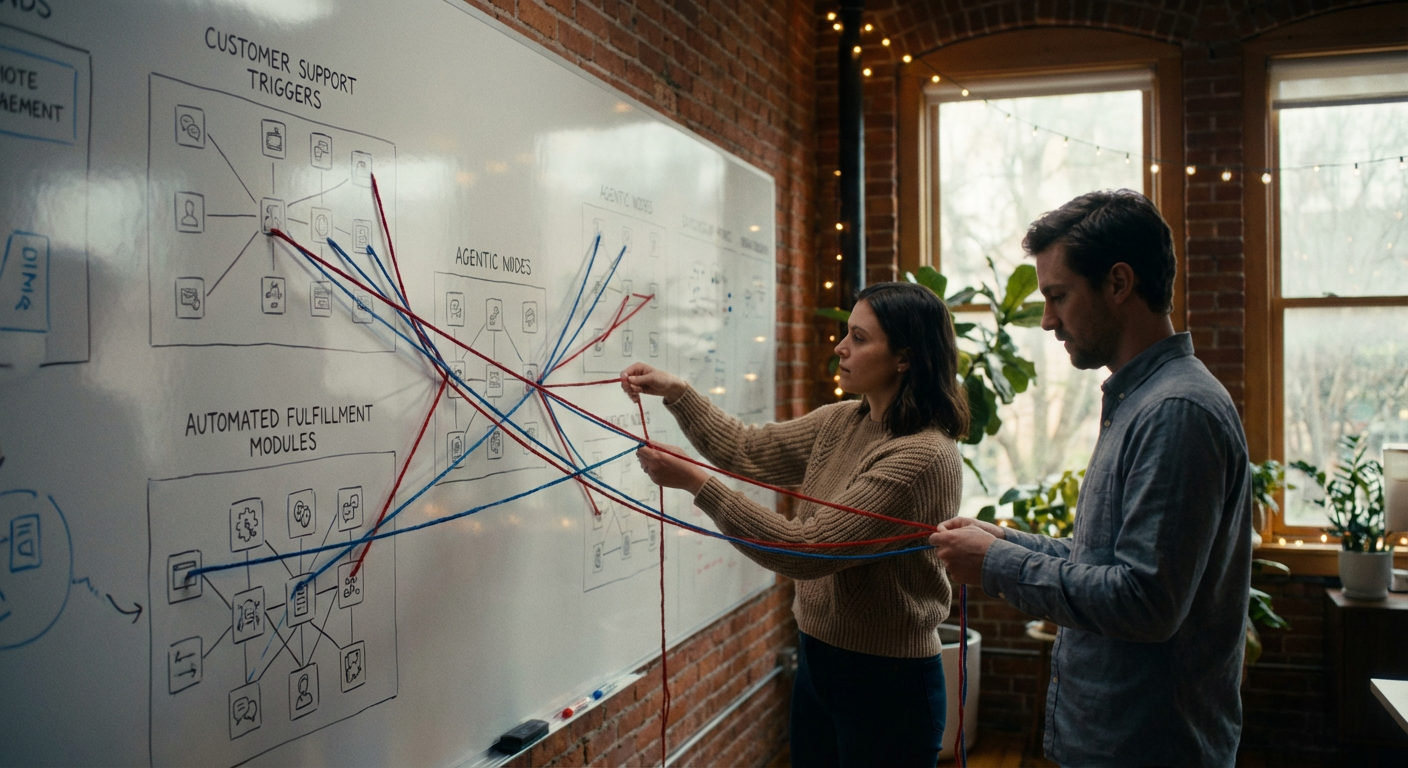
An agentic workflow doesn't wait for a prompt. It operates on triggers. It monitors a shared inbox, detects a specific type of customer complaint, drafts a response based on the company's specific tone-of-voice guidelines, checks the inventory database to see if a refund is possible, and then—and only then—pings a human for a final "thumbs up." This transition marks a significant step towards more autonomous workflows, as discussed in "Harnessing Agentic AI: Transforming The Property And..."
This shift requires a new mindset. You are no longer a "user" of software; you are an architect of logic. However, the bottleneck has historically been the code. Building these complex chains used to require a team of DevOps engineers. This is changing rapidly.
As we move toward human-AI collaboration 2026, the barrier to entry is crumbling. For example, the concept of an "agentic organization" suggests a new operating model for the AI era. Platforms that offer an artificial intelligence automation platform are critical in this transition, allowing business leaders to build AI automations without being engineers. By democratizing the architecture layer, we move the power from the IT department back to the operational experts who actually understand the business problems.
The "Context Mesh" Problem
Why haven't we done this sooner? Context. Until recently, AI models were amnesiacs. They didn't know who you were, what you did yesterday, or what your company policy was regarding refunds.
Recent research highlights the explosion of applied AI innovation. According to a study published in Nature, "A Global Dataset Mapping the AI Innovation from Academic...", the trajectory of AI patents and publications suggests a massive pivot toward application-layer technologies that integrate deep learning into practical systems. This data confirms that the "science" phase is settling, and the "engineering" phase is ramping up. The winners will be those who can create a "context mesh"—a workflow where the AI remembers the history of a client relationship across email, Slack, and CRM, acting on that holistic view rather than a single data point. The idea of "categorical perception" in AI, as explored in various computer science contexts, underlines the importance of AI's ability to categorize and understand context for effective operation.
AI Concierge Agents and the New Employee Experience
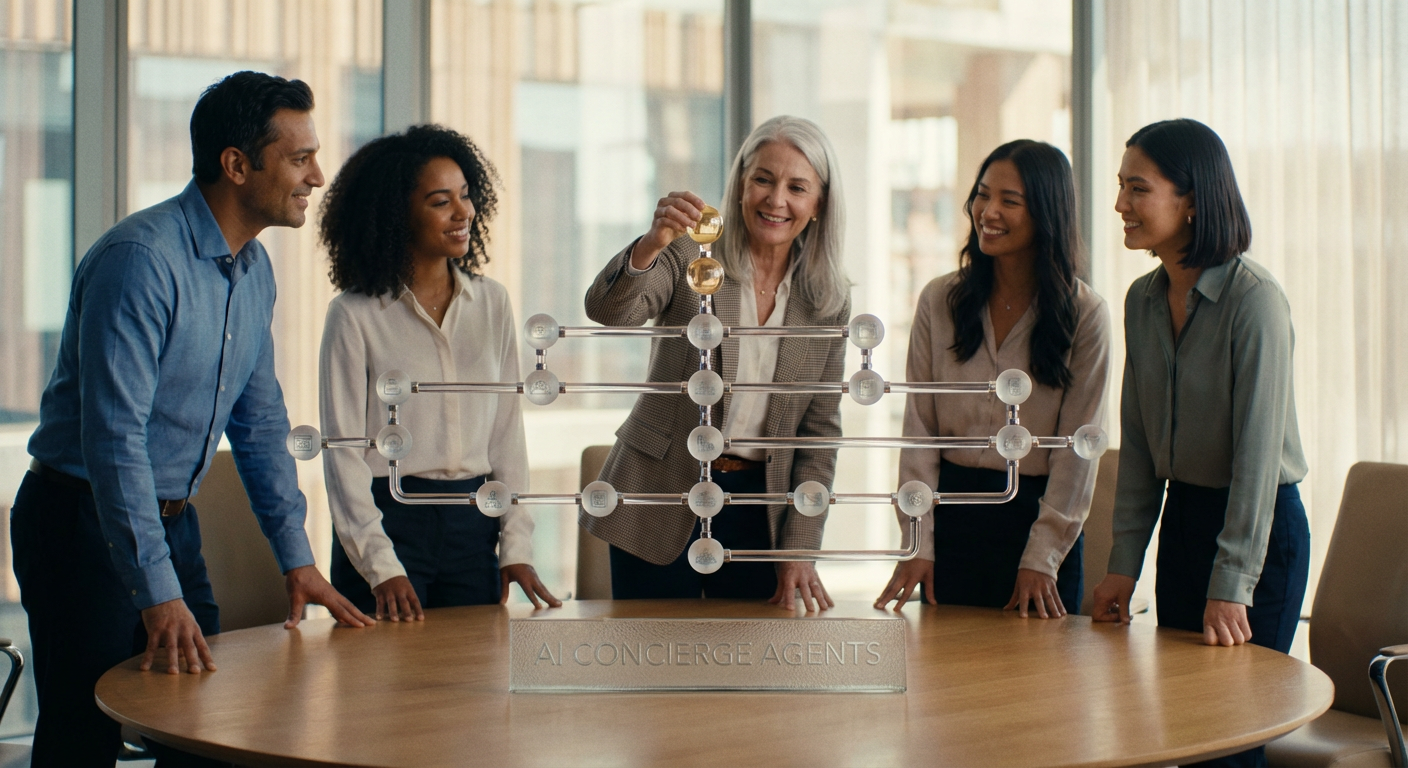
One of the most profound digital transformation trends we will see mature by 2026 is the internalization of AI. We talk a lot about AI for customer support, but the real ROI lies in AI-driven employee experience.
Imagine an AI concierge agent dedicated to every employee. This isn't a generic chatbot. It is an agent deeply integrated into the company's internal wiki, HR portal, project management tools, and Slack channels.
The Workflow of 2026:
- —The Scenario: A marketing manager, Sarah, needs to book emergency leave and hand off a campaign to a colleague.
- —The Old Way: Sarah emails HR, waits for approval, updates the project board, emails her colleague, shares drive folders, and sets an OOO responder.
- —The AI Concierge Way: Sarah types into her enterprise interface: "I have a family emergency and need to be off until Monday. Hand the 'Alpha' campaign to Mike."
- —The Execution: The agent checks her accrued leave, files the request with HR, updates the Asana board, drafts a briefing document for Mike based on Sarah's recent activity on the Alpha files, grants Mike permissions to those files, and sets Sarah’s OOO message.
This links heavily to the concept of assistive technology evolving into proactive partnership. A working paper from the Harvard Kennedy School regarding the "Future for AI, Machine Learning and Assistive Technology..." suggests that as these technologies mature, they will significantly reduce the administrative overhead that currently plagues knowledge workers. The goal is to free humans to do the one thing AI cannot effectively do: care about the outcome. The emergence of agentic commerce also indicates a new era for consumers and merchants, driven by these AI advancements.
From "Human-in-the-Loop" to "Human-on-the-Bridge"
There is a pervasive fear that agentic workflows remove human agency. This is a misunderstanding of the workflow hierarchy. We are not removing humans; we are elevating them.
In a traditional "Human-in-the-Loop" workflow, the AI does a task, stops, and waits for the human to check it. The human is a cog in the machine. In a "Human-on-the-Bridge" workflow (the Star Trek metaphor), the AI runs the ship's systems autonomously. The human captain sits on the bridge, monitoring the dashboard, setting the destination, and intervening only when anomalies occur.
This shift creates a psychological tension. It raises questions about responsibility. A fascinating study in ScienceDirect titled "Are we ghosts in the machine? AI, agency, and the future of..." explores this dynamic. As algorithms take over decision-making processes, organizations must clearly define where the "ghost" (human intent) resides. The workflow must be designed so that the human feels in control even when they aren't executing the keystrokes.
Practical Application: The "Review, Don't Do" Model
To implement this by 2026, companies need to change their review processes.
- —Junior Employee Role: Shifts from "drafting content" to "auditing AI outputs."
- —Senior Leader Role: Shifts from "management of people" to "management of system logic."
If you find yourself manually copying data from a spreadsheet to an email more than once a week, you have failed to adapt. Tools that allow for visual building of these flows—like an AI automation platform—enable you to map out this "Bridge" strategy without needing to understand the underlying Python scripts. You define the triggers, the actions, and the safety checks, and then you step back onto the bridge.
The Ethics of Efficiency: Purpose-Driven Automation
As we rush toward hyper-efficiency, there is a risk of automating the humanity out of business. Just because an AI can write a condolence email to a client, doesn't mean it should.
MIT Press published a vital piece on "Principles to Guide a Purpose-Driven AI Future". It argues that workflows must be designed with ethical guardrails. In 2026, the best workflows will have "friction by design." The implications of AI on creativity and ethical considerations are also explored in "Artificial Humanities: A Literary Perspective on Creating and..."
Friction by Design implies:
- —High-Stakes Decisions: The AI prepares the data, but is hard-coded to require human execution (e.g., firing an employee, denying a loan, admitting a patient).
- —Creative nuance: AI generates variations, but humans curate the final emotional arc.
Furthermore, as generative AI floods the world with content, distinguishing signal from noise becomes critical. As noted in "Generative artificial intelligence in scientific publishing", the proliferation of AI-generated text requires new workflows for verification and quality control. Your business workflows must include "fact-checking nodes"—steps in the process specifically designed to hallucin-check the AI before data leaves the organization.
5 Steps to Future-Proof Your Workflows Today
You don't need to wait for 2026 to start acting like a future-ready company. Here is the roadmap:
- —Audit for Repetition, Not just Volume: Don't just look for big tasks. Look for small, annoying tasks that break focus. An AI agent handling calendar invites saves only 5 minutes, but it preserves 20 minutes of flow state.
- —Map the "White Space": Look at the space between your apps. Where does data get lost? Where do you have to copy-paste? That is where your agent should live.
- —Invest in Low-Code/No-Code Orchestration: Stop buying disparate tools. Invest in orchestration layers. Solutions that help build AI automations are valuable because they act as the glue between the tools you already use, rather than adding another silo.
- —Define Your "Human-Only" Zones: Explicitly list the tasks that AI is grounded from touching. This builds trust with your team and your customers.
- —Treat Workflows as Products: Your internal workflows are products. They have users (your employees). Iterate on them. Get feedback. If the AI agent is annoying, "fire" (reprogram) it.
Conclusion: The Invisible Advantage
The future of AI workflows isn't about a better chatbot. It’s about invisibility. The best technology is the kind you don't realize is there until it stops working.
By 2026, we won't be talking about "using AI" any more than we talk about "using electricity" today. It will just be how business is done. The workflows will run silently in the background, connecting intent to action, data to decision, and employee to solution.
The competitive advantage won't go to the company with the smartest algorithm. It will go to the leaders who have the courage to reimagine their organizations not as a collection of job titles, but as a symphony of automated and human workflows, playing in perfect sync.
The bridge is open. Take the captain's chair.
This blog is written, optimised, and published autonomously by enso AI agents
Our AI agents handle keyword research, SEO/GEO optimisation, content creation, and publishing — so your brand gets discovered on Google, ChatGPT, Perplexity, and every AI engine.