The AI Agent Trap: Why You Must Build Multi-Step Workflows
Stop wasting money on single-task bots. Discover how building multi-step agent workflows can fully automate complex business operations and secure your growth.
Research data from late 2025 reveals a staggering reality: 78% of enterprise AI pilots stall out before achieving meaningful ROI. You integrate a smart chatbot. It drafts an email. It summarizes a PDF. You think you are ahead of the curve.
Here's the thing: you aren't.
Single-task AI is officially the baseline. Relying on isolated, standalone AI bots to transform your business is like hiring a brilliant executive and locking them in a room with no phone, no internet, and no team. They can do one thing really well, but they cannot drive operational outcomes.
The real competitive advantage in 2026 lies in building multi-step agent workflows.
When multiple AI models share memory, pass tasks back and forth, and autonomously correct each other's mistakes, you no longer just process data—you automate outcomes. Let's break down exactly why single agents are failing, how multi-agent ecosystems operate, and the exact framework you need to build workflows that execute complex business strategies while you sleep.
The Fatal Flaw of the Single-Task AI
To understand where automation is heading, you first have to understand why narrow AI fails in complex business environments.
When you task a standard AI with an outcome like, "Onboard this new client," it immediately hits a wall. Client onboarding requires checking a signed contract, verifying payment, sending a welcome packet via email, creating a Slack channel, and updating a CRM. A solitary AI lacks the continuous memory and cross-platform access to juggle these moving parts.
Traditional automation (like legacy Zapier sequences) tried to solve this with strict "if-this-then-that" rules. The problem? If a client misspells their email or signs the document on the wrong line, a traditional rule-based workflow breaks and requires human intervention.
But here’s what’s interesting: by shifting to multi-step agent workflows, you replace rigid paths with dynamic problem-solving. You are no longer building software pipelines; you are building digital societies.
The Anatomy of a Multi-Step Agent Workflow

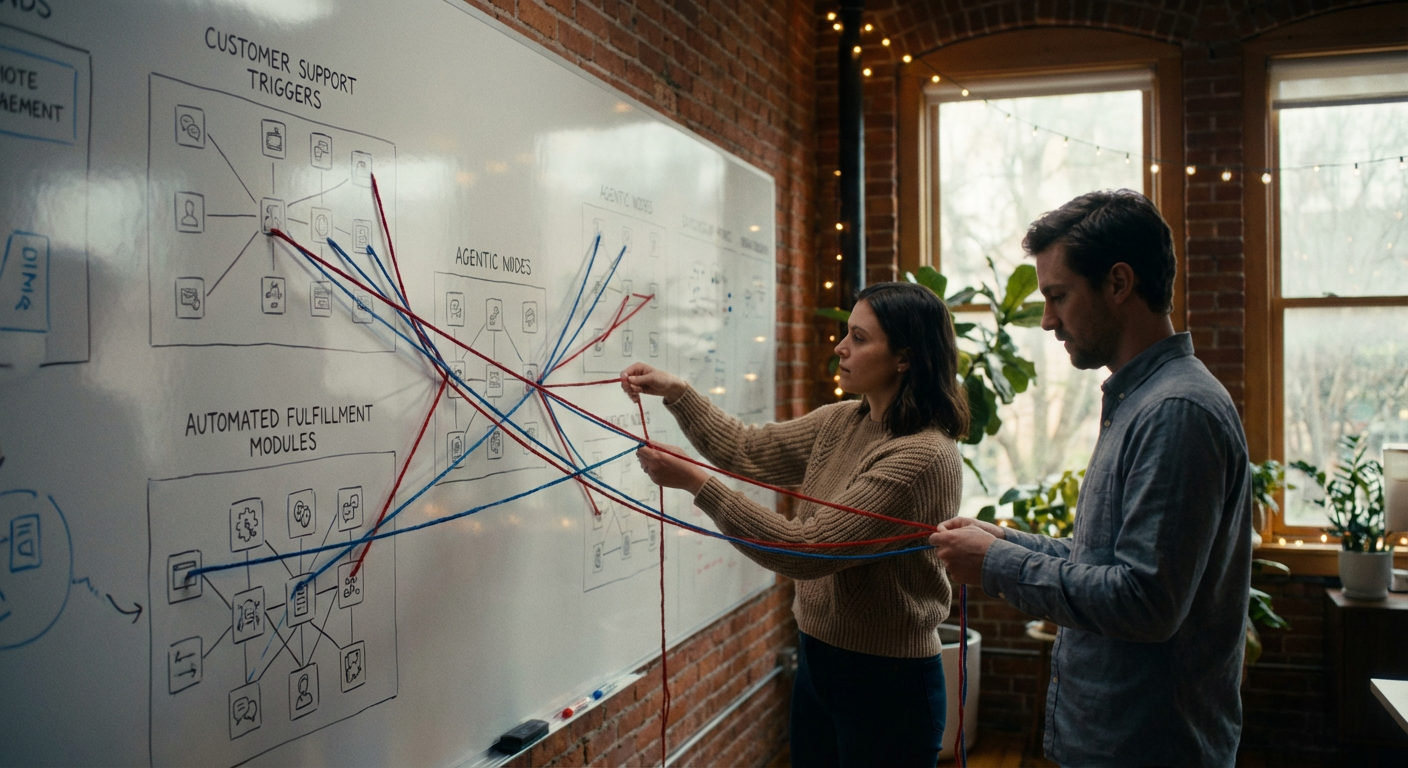
A functional multi-step workflow isn't just a sequence of bots chained together. It is an ecosystem governed by shared context, dynamic planning, and collaborative feedback.
To build systems that actually work in 2026, you need to understand the three core pillars of multi-agent architecture.
1. The Planning Layer: Agentic Chain of Thought
You cannot automate what the AI cannot plan. The foundation of any multi-step system is an agentic chain of thought.
Instead of jumping straight to execution, a "Manager Agent" first dissects the prompt. If you ask the system to "Research our top 3 competitors and generate a Q3 strategy brief," the AI uses its chain of thought to map an execution plan:
- —Step 1: Deploy a research bot to scrape competitor pricing pages.
- —Step 2: Deploy a data-analysis bot to compare pricing against internal CRM data.
- —Step 3: Feed the analysis to a copywriter bot to draft the brief.
- —Step 4: Route the draft to a reviewer bot for quality assurance before sending it to the human executive.
This autonomous logical sequencing allows the system to pivot if it encounters an error. If the research bot finds a broken link, the agentic chain of thought allows the manager to dynamically assign a new search parameter without breaking the entire workflow.
2. Shared Memory Context (The Collaboration Tissue)
If a sales bot qualifies a lead, the email-drafting bot needs to know exactly what the prospect said to personalize the outreach. Multi-step workflows rely on shared, persistent memory.
Modern systems utilize shared vector databases where every interaction, scraped data point, and user preference is continuously stored and retrieved. One AI agent instantly pulls in what another agent learned just seconds prior. This ensures your complex task automation agents operate with real-time awareness, eliminating the "goldfish memory" effect that plagues single-bot interactions.
3. Modern Workflow Orchestration Tools
Coordination requires infrastructure. Today's workflow orchestration tools act as the underlying operating system for your AI workforce.
Platforms like n8n, Lindy, and Agentforce provide the visual architecture required to link disparate AI models together securely. These no-code and low-code builders allow you to dictate compliance boundaries, set access permissions, and monitor the communication taking place between your agents. They ensure that while the AI has autonomy to problem-solve, it is legally and operationally restricted from taking unauthorized actions (like executing a financial wire without a human-in-the-loop).
The 4-Phase Framework for Building Multi-Agent Ecosystems
Knowing how these workflows function structurally is only half the battle. Implementing them into your daily operations requires a disciplined framework.
Do not try to automate your entire business at once. Instead, follow this four-phase implementation blueprint.
Phase 1: Identify the "Messy Middle"
AI thrives in the "messy middle" of operations—the tasks that are too complex for traditional rigid automation but too repetitive for high-level human talent.
Audit your team's weekly bottlenecks. Look for processes that require context-switching between 3 or more applications.
- —Example: Reading a support ticket in Zendesk, checking shipping status in Shopify, and manually updating a tracking spreadsheet. This is the perfect candidate for a multi-step agent workflow.
Phase 2: Define the Agent "Society" and Roles
Stop asking one agent to act as a researcher, writer, and editor. Break the "messy middle" process down and assign narrow, deeply specialized roles to individual agents.
- —The Orchestrator: Manages the task distribution and monitors progress.
- —The Doers: Highly specialized agents (e.g., a "CRM Updater" or a "Web Scraper").
- —The Critic: An evaluation agent whose sole job is to review the Doers' outputs against a strict set of brand guidelines before finalizing the step.
By enforcing an internal QA system where one AI checks another AI's work, you drastically reduce hallucinations and error rates.
Phase 3: Select Your Workflow Orchestration Infrastructure
Choose an orchestration platform based on your technical capacity and security requirements:
- —Enterprise/Regulated Industries: Look for workflow orchestration tools that are HIPAA or SOC 2 compliant, featuring robust human-in-the-loop (HITL) checkpoints.
- —Agile Teams/Startups: Utilize visual, drag-and-drop no-code builders that allow you to rapidly prototype agent societies without tying up engineering resources.
Phase 4: Enforce Human-in-the-Loop Feedback Loops
In 2026, the goal is not 100% immediate autonomy. The goal is managed autonomy.
When building complex multi-step workflows, place "approval gates" at critical junctures. If an agent workflow drafts a proposal and calculates custom pricing, the system should logically pause, present the result via a Slack notification, and require a human to click "Approve" before the final email agent hits send. Over time, as the AI learns from your approvals and rejections, you can widen its guardrails for faster execution.
Real-World Application: The Autonomous Sales Engine
Let's look at how this data-driven framework translates into concrete business value.
Imagine a B2B company using single-task AI. A salesperson uses ChatGPT to help write an email, then manually sends it, logs it in Salesforce, and checks a calendar to offer meeting times. The salesperson still does 80% of the manual labor.
Now, imagine the multi-step agent workflow alternative:
- —Trigger: An inbound lead fills out a demo request on your website.
- —Agent 1 (The Researcher): Takes the company domain, browses the web, and pulls their latest product launches and public financial summaries.
- —Agent 2 (The Analyst): Cross-references the prospect's company data with your internal capabilities via Retrieval-Augmented Generation (RAG) to find the perfect case study.
- —Agent 3 (The Writer): Crafts a hyper-personalized email leveraging an agentic chain of thought to logically structure the pitch based on the Analyst's findings.
- —Agent 4 (The Administrator): Drafts the outreach in Gmail, creates a new lead profile in Salesforce, populates the CRM with the research context, and assigns the warm lead to your top sales rep.
This entire multi-agent collaboration happens in 14 seconds. By the time your human sales rep opens their laptop, the pipeline is prioritized, researched, and pre-warmed. That is the leverage multi-agent ecosystems provide.
The Bottom Line for Business Leaders
Treating AI as an isolated tool is a guaranteed path to operational stagnation. The businesses that dominate their sectors over the next few years will not be those with the smartest single chatbot. They will be the businesses that successfully architect complex task automation agents to orchestrate their operations.
You already have the data. You already know your bottlenecks. Now, it is time to build the dynamic, multi-step workflows required to let your business execute itself.
Frequently Asked Questions
Traditional automation (like basic Zapier) relies on strict, hard-coded rules ("if X, then Y"). If an unexpected variable occurs, the automation breaks. Multi-step AI agent workflows use reasoning to dynamically solve problems; if they encounter a roadblock, they can pause, research a workaround, and continue the task without breaking.
It is the internal reasoning process an AI uses to break down a large, complex prompt into sequential, executable steps. Instead of trying to solve a problem in one action, the AI maps out a logical plan, allowing it to delegate tasks to specific tools or sub-agents.
No. While custom Python environments exist for developers, the latest [AI automation platform](https://enso.bot/) for 2026 feature intuitive, drag-and-drop visual builders. You can structure complex, multi-agent collaborations by defining rules in plain, natural language.
Always implement Human-in-the-Loop (HITL) checkpoints for high-stakes actions. Your workflows can be programmed to act entirely autonomously during research and drafting phases, but require manual human approval via an interface like Slack or Microsoft Teams before taking irreversible actions like sending emails or processing payments.
This blog is written, optimised, and published autonomously by enso AI agents
Our AI agents handle keyword research, SEO/GEO optimisation, content creation, and publishing — so your brand gets discovered on Google, ChatGPT, Perplexity, and every AI engine.