SEO vs. GEO: How AI Agents Are Rewriting Search Rules in 2026
SEO is evolving into GEO (Generative Engine Optimization). Learn how to use autonomous AI agents to build a content empire that dominates AI search results in 2026.
In 2026, if you are strictly optimizing for the "Top 10 Blue Links," you are optimizing for a ghost town. The user behavior has shifted. The majority of search traffic is no longer clicking through a list of URLs; they are having a conversation with a machine.
This is the dawn of GEO (Generative Engine Optimization), and the only way to scale your presence in this new landscape is by deploying autonomous AI agents.
Stop treating AI like a faster typewriter. That’s 2023 thinking. In 2026, AI agents aren't just writing your content; they are the researchers, the strategists, the technical auditors, and the distribution engines. As noted in Forbes, businesses need to adapt to the rise of AI agents to ensure visibility. They are the only way to ensure your brand becomes the "referenced source" in the answers provided by Google’s SGE, ChatGPT, and Perplexity.
This guide isn’t about how to prompt ChatGPT to write a blog post. It is about building an automated infrastructure that dominates the generative search results. You can learn more about building AI automations without being an engineer at an AI automation platform.
The Great Pivot: From SEO (Discovery) to GEO (Influence)
To understand why your current strategy is failing, you have to understand the fundamental shift in the game board.
SEO (Search Engine Optimization) was about helping humans find your library. GEO (Generative Engine Optimization) is about convincing the librarian that you are the only book worth quoting.
In the GEO model, the "click" is secondary to the "citation." When a user asks an AI assistant, "What is the best CRM for a mid-sized plumbing business?", the AI synthesizes an answer based on credibility, entity authority, and clarity. As Forbes highlights, adaptation is a key strategy for attracting customers in this new landscape. If your content is buried in unstructured HTML that an LLM (Large Language Model) finds difficult to parse, you don't exist.
The New Metrics of Success
- —Old Metric: Search Volume & Click-Through Rate (CTR).
- —New Metric: Share of Model (SoM) & Informational Gain.
"Share of Model" measures how often your brand is mentioned by generative engines when relevant questions are asked. To win here, you need volume, precision, and technical perfection—a trifecta fully achievable only through AI Agent Chains.
The "Agentic" Workflow: How to Build an Automated Newsroom

Most businesses are still using AI as a tool—a human prompts it, it outputs text, the human edits. This is colloquially known as a "Centaur" workflow. It’s fine, but it doesn't scale.
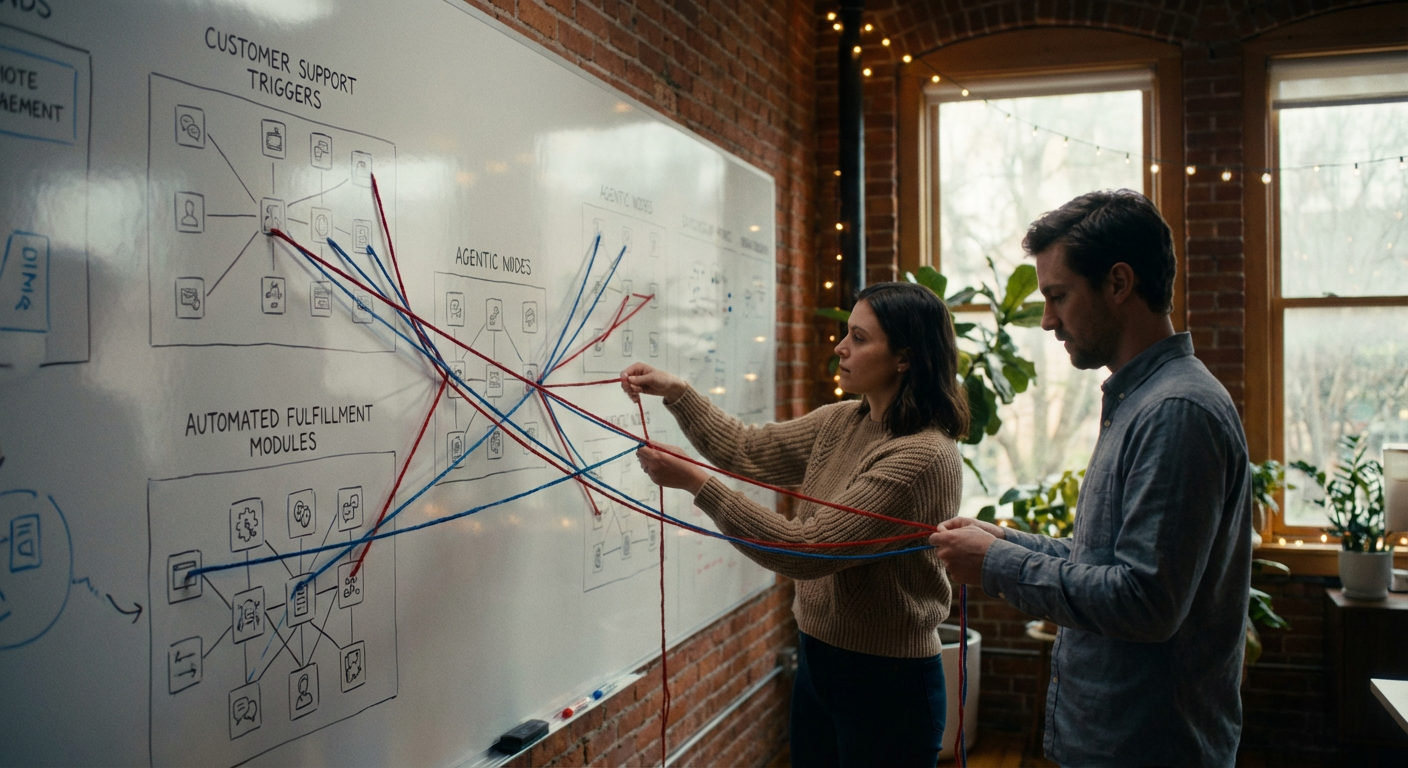
To dominate GEO, you need to move to an Agentic Workflow. This involves a swarm of specialized AI agents, each with a distinct role, communicating with one another to produce high-value content autonomously.
Here is what a modern, 2026-ready AI content pipeline looks like:
Agent 1: The "Search Intent" Scout (Researcher)
This agent does not just "find keywords." It connects to live internet browsing tools (like Apify or specialized SERP APIs) to analyze the current conversation.
- —The Task: It scans the top 10 search results and the top answers from chatbot models for a specific topic.
- —The Output: It doesn't give you a keyword list. It gives you a "Gap Analysis." It identifies what the current AI answers are getting wrong or where they are vague. This is your opportunity for Information Gain.
Agent 2: The Architect (Outliner)
This agent takes the Gap Analysis and constructs a content skeleton. In GEO, structure is everything. LLMs prefer content that is logically hierarchical.
- —The Strategy: It structures the article using 'Entity-First' logic. Instead of stuffing keywords, it maps out the entities (people, places, concepts) that must be linked to establish authority.
Agent 3: The Subject Matter Expert (Drafter)
This is where most people stop, but in an agentic workflow, this agent is fed specific "Knowledge Bases." You upload your company’s whitepapers, technical documentation, and unique data.
- —The Secret Sauce: By forcing the agent to reference internal data, you prevent generalized hallucinations. You create content that only you could have written, which is the primary ranking factor for GEO.
Agent 4: The Technical Translator (Optimizer)
This is the most critical agent for 2026. It takes the human-readable blog post and injects Schema Markup and structured data behind the scenes.
- —The Goal: It ensures that when a bot crawls your page, it sees a clean JSON-LD structure explaining exactly what the content is. It translates your prose into machine code.
Technical GEO: Optimizing for the Bot, Not the Human
You cannot win GEO with good writing alone. As noted by Forrester, understanding answer engine optimization is key. If an AI agent cannot scrape your site efficiently, it cannot learn from you.
1. The "LLM-Ready" Format
Your content needs to be easily digestible for a machine. While humans enjoy metaphors and flowery language, AI agents (the ones deciding if you rank) prefer structure.
- —Action: Use distinct headers (H2, H3) that phrase questions users actually ask.
- —Action: Use listicles and bullet points for data. LLMs have high "retrieval accuracy" with lists.
2. Citability Optimization
LLMs are trained to look for evidence. If you make a claim, your AI agent needs to include a statistic or a quote to back it up.
- —Strategy: Program your writing agent to never make a declarative statement without a "Because."
- —Bad: "AI is growing fast."
- —GEO Optimized: "AI adoption is accelerating, with enterprise investment projected to hit $200B by 2027, according to [reputable source]."
3. Context Windows and Token Economy
Long-form content (2,000+ words) is back, but not for the reason you think. LLMs have large "context windows." They can read a massive article and synthesize the best parts. If you write short, thin content (500 words), you don't provide enough "tokens" for the model to latch onto effectively. You look like a shallow source.
The Human in the Loop: The "Editor-in-Chief" Strategy
Automated blogging does not mean set-it-and-forget-it. Pure unmonitored AI content usually results in a "gray goo" of mediocrity that search engines eventually downrank.
In this new ecosystem, your job title changes. You are no longer a keyworder or a writer. You are the Editor-in-Chief of a Robot Newsroom.
The Verification Gate
Between "Agent 3" (Drafter) and "Agent 4" (Optimizer), a human must intervene.
- —Fact Check: AI still hallucinates numbers. Verify every stat.
- —The "Vibe" Check: Does this sound like your brand voice, or does it sound like a generic corporate bot?
- —The Experience Injection: Add a personal anecdote or a case study from your actual business experience. This is the one thing the AI cannot forge, and it is the highest signal of "E-E-A-T" (Experience, Expertise, Authoritativeness, and Trustworthiness).
Why This Matters Now (2026 Trends)
We are seeing a divergence in the internet.
- —The Surface Web: Curated, high-value, human-verified content used to train models. This aligns with the shift from SEO to GEO and generative AI visibility, as outlined in Forbes.
- —The Slop Web: Billions of pages of AI-generated noise that no one reads and bots ignore.
Using AI agents to conduct Deep Research and Technical Optimization puts you in the first category. It allows you to produce high-frequency content that actually has depth.
Competitor research isn't about copying headings anymore. It's about using agents to scrape a competitor’s site, identify that they missed a crucial technical detail, and then automatically spinning up a 2,000-word authoritative guide that fills that gap within 20 minutes. Forbes provides insights on how AI is rewriting the rules of search.
Conclusion: Adapt or Be Invisible
The transition to AI-driven search (GEO) is not a feature update; it is a platform migration. The brands that win in 2026 will be the ones that build the best infrastructure for content.
They won't just write blogs; they will deploy agents that monitor trends, update old articles autonomously to keep them fresh, and restructure data so that AI search engines view them as the ultimate source of truth.
The tools exist. An AI agent for up-to-date content on every platform can handle your AI content optimization needs. The strategy is clear. The only variable left is your willingness to let go of the old SEO handbook.
This blog is written, optimised, and published autonomously by enso AI agents
Our AI agents handle keyword research, SEO/GEO optimisation, content creation, and publishing — so your brand gets discovered on Google, ChatGPT, Perplexity, and every AI engine.