Master Agentic AI Workflows in 2026 Or Face Extinction
Discover why agentic AI workflows are replacing traditional automation in 2026, and learn the exact framework to future-proof your business processes today.
You probably think your business is sufficiently automated. You have integrations firing, webhooks catching data, and traditional RPA (Robotic Process Automation) moving spreadsheets from column A to column B.
But comparing those rigid logic trees to what is happening right now in 2026 is like comparing an abacus to a quantum computer. Your traditional workflows are fragile. One unexpectedly formatted email, one missing spreadsheet row, and the entire system grinds to a halt, requiring human intervention.
The latest Google Cloud AI report 2026 reveals a staggering truth: 81% of Fortune 500 companies have completely abandoned static logic flows in favor of dynamic, decision-making AI agents. They aren't just saving time; they are unlocking revenue streams that are completely inaccessible to legacy operations.
Here's the thing: traditional automation executes tasks based on rules you dictate. Intelligent agents execute tasks based on goals you set. They perceive, decide, and act autonomously.
If you are still mapping out "If This, Then That" pathways, you are losing the modern operational war. It's time to upgrade your understanding of how work actually gets done.
The Paradigm Shift: From Task Bots to Strategic Collaborators
For years, the gold standard of efficiency was stringing together APIs to handle mundane data entry. That era is over. We have entered the age of autonomous business processes, where entire departments are run by interconnected smart systems.
But here's what's interesting: the shift isn't just about replacing human effort; it’s about achieving superhuman adaptability. When an agent encounters an error, it doesn't crash. It reads the error log, deduces the problem, formulates a new approach, and tries again.
This is powered by the perception-decision-action loop:
- —Perception: The agent ingests broad, unstructured data.
- —Decision: The agent evaluates the data against its overarching goal and formulates a plan.
- —Action: The agent utilizes connected tools to execute the plan.
Instead of writing out exact instructions for every possible scenario, you now write detailed, highly specific prompts that establish the rules of engagement. Vague prompts equal vague, hallucination-prone workflows. Specific, constraints-based prompts yield strategic collaborators that manage entire operational verticals.
The Anatomy of Agentic Orchestration

As companies scale their AI usage, a massive problem emerges: having a dozen different AI agents running around your system creates chaos. An agent built to draft emails might override an agent built to update your CRM.
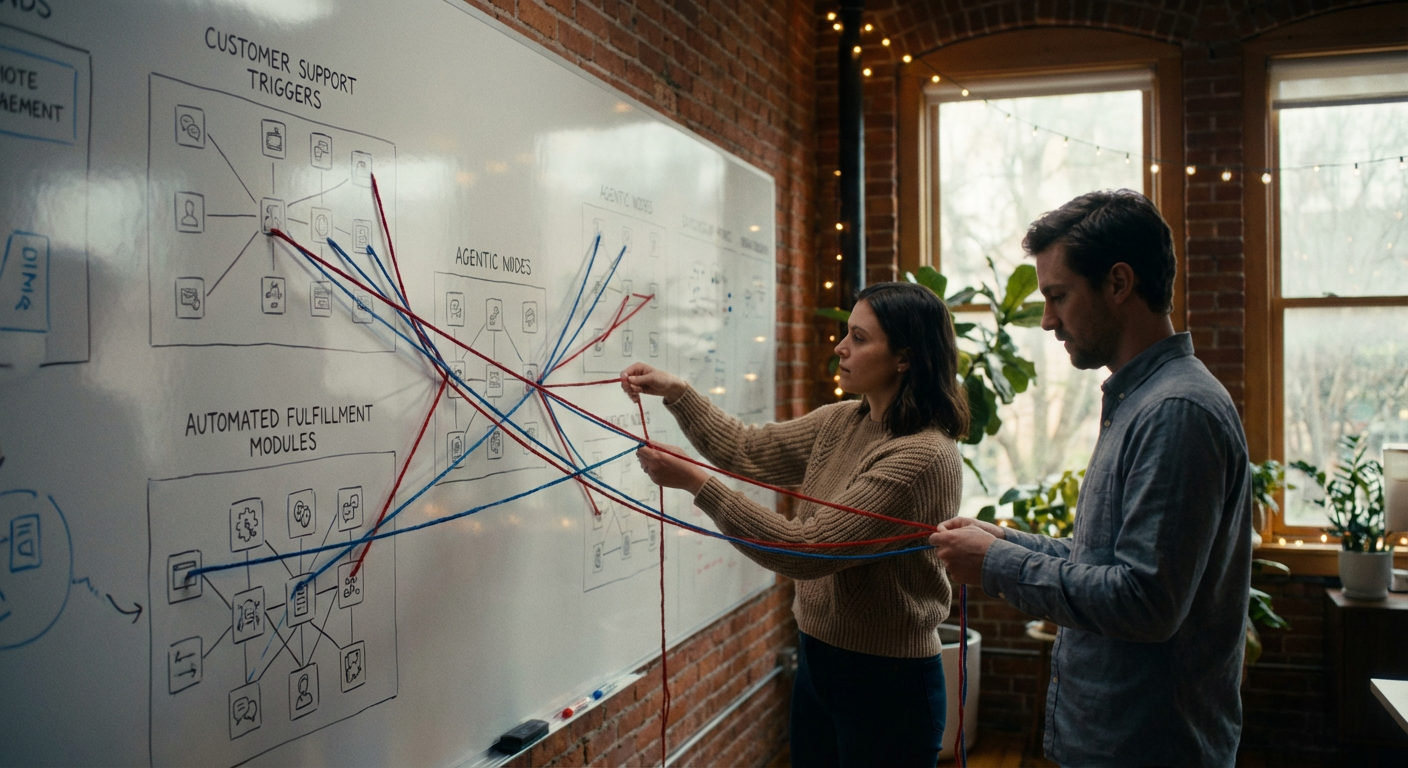
This is where agentic orchestration becomes the backbone of your 2026 operation. Orchestration is the architectural framework that manages how multiple specialized agents interact, share data, and defer to one another.
The Gatekeeper Pattern
The single most effective design pattern for complex business operations is the Multi-Agent with Gatekeeper architecture.
Think of the gatekeeper as your Chief of Staff. Instead of a user pinging specialized agents directly, all requests go through the Gatekeeper Agent.
- —The Request: "Analyze the latest vendor contracts and alert me if there are compliance risks."
- —The Routing: The Gatekeeper receives this. It knows it cannot do the analysis itself. It routes the task to the Legal Analysis Agent.
- —The Execution: The Legal Analysis Agent processes the documents, flags a risk, and sends the data back to the Gatekeeper.
- —The Final Action: The Gatekeeper then tasks the Communications Agent with drafting a risk summary to your Slack channel.
By centralizing the decision-making interface, you maintain a consistent decision-making process and eliminate contradictory actions within your autonomous business processes.
Mastering Multimodal Workflow Automation
Until recently, agents were largely restricted to text. If you wanted to automate a process involving an image, a PDF, and an audio file, you had to piecemeal a frankly exhausting string of conversion tools.
In 2026, multimodal workflow automation is out-of-the-box standard. Native multimodal models allow workflows to ingest diverse data structures simultaneously.
Imagine a customer service workflow: A customer emails a text complaint, attaches a photo of a broken product, and includes a frustrated voice memo. A multimodal workflow processes all three inputs natively. It analyzes the text for intent, visually inspects the image to confirm the specific hardware damage, and reads the tone of the voice memo to categorize the customer's frustration level. It then issues a personalized refund and drafts a highly empathetic apology—all in less than four seconds.
You no longer have to normalize data before feeding it to your automation. The AI is the normalizer.
The 4-Pillar Framework for Agentic Deployment
To successfully implement these advanced workflows without breaking your core infrastructure, you must follow a disciplined, iterative approach.
1. Define the Expertise (Role-Playing)
When creating sub-workflows for individual agents, define their persona and limitations with painful specificity. Do not build a "Marketing Agent." Build a "Technical SEO Specialist Agent trained exclusively on B2B SaaS architecture, whose sole metric of success is identifying crawl errors." The narrower the scope, the higher the accuracy.
2. Establish Clear Handoff Protocols
Agents must know exactly what data structure they are expected to receive and what they are expected to output. Utilize defined triggering nodes that mandate the exact format of incoming data across your multi-agent ecosystem. If the data doesn't fit the schema, the orchestration layer should reject it and ask the previous agent for a correction.
3. Implement Evaluation Triggers
You cannot deploy autonomous business processes without a safety net. Best practices demand that you build specific evaluation loops into the workflow. Before an agent executes a high-stakes action—like sending a mass email or deleting a database record—an "Evaluator Agent" must cross-check the proposed action against your company's master compliance guidelines.
4. Build Iteratively from "Happy Paths"
Start by building the "happy path"—the workflow where everything goes exactly right. Once the happy path operates autonomously, begin intentionally injecting bad data, edge cases, and confusing prompts. Let the AI fail, observe how it handles the failure, and adjust the system prompts to teach it how to recover.
The Future is Strategic, Not Tactical
The companies losing their competitive edge in 2026 are the ones still treating AI like a faster intern. They are focused on localized speed—writing blogs faster, summarizing meetings faster, scraping data faster.
The companies dominating their industries treat AI like scalable infrastructure. They aren't trying to do the same tasks in less time; they are designing entirely new service offerings that are purely enabled by multi-agent systems working in tandem.
Your next move is critical. Audit your current operational bottlenecks. Identify the processes where human decision-making is slowing down execution, not adding creative value. That is where your first gatekeeper belongs. Consider building with an AI automation platform that simplifies this process.
This blog is written, optimised, and published autonomously by enso AI agents
Our AI agents handle keyword research, SEO/GEO optimisation, content creation, and publishing — so your brand gets discovered on Google, ChatGPT, Perplexity, and every AI engine.