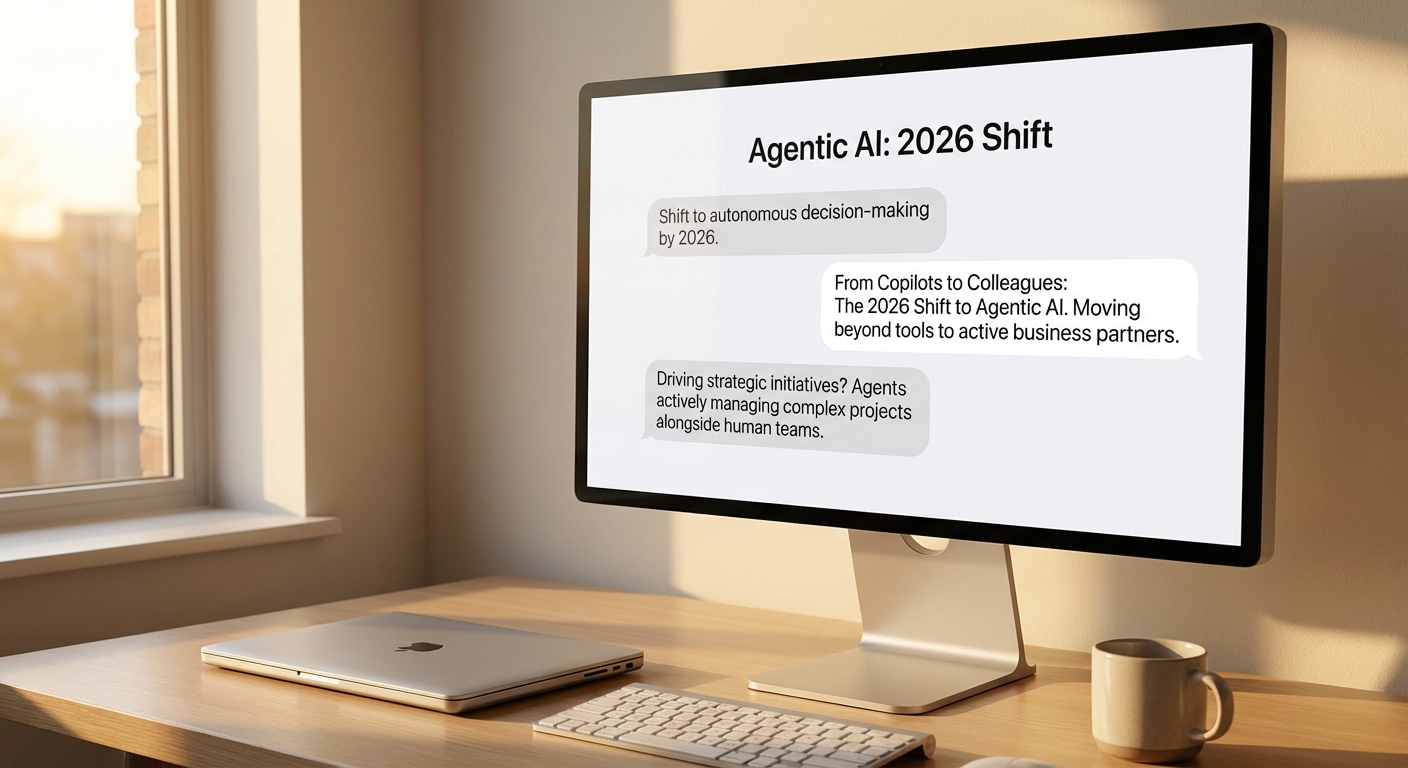
From Copilots to Colleagues: The 2026 Shift to Agentic AI
The era of the chatbot is over. 2026 is the year of Agentic AI—autonomous agents that don't just talk, but execute. Here is your roadmap to the shift.
Stop Chatting. Start Automating.

The "shiny object" phase of Artificial Intelligence is officially over. If your 2026 AI strategy still relies on employees pasting text into a chatbot window and hoping for a good draft, you aren't innovating—you’re just procrastinating with a more expensive calculator.
For the last three years, we have treated AI like a very smart, very hallucination-prone intern locked in a room with no internet access. We ask it questions, it gives us answers, and then we have to go do the actual work.
That workflow is dead.
Welcome to the era of Agentic AI. This is the shift from "Generative AI" (machines that think and write) to "Active AI" (machines that do). The defining business trend of 2026 isn't about better prompts; it's about handing over the keys—specifically, the API keys—to autonomous AI agents that can navigate your software ecosystem, make decisions, and execute complex workflows while you sleep.
Here is why 2026 is the year the "Copilot" becomes the "Colleague," and how your business survives the transition.
The Core Shift: From "What do you think?" to "Go do this."

To understand AI agent trends 2026, you have to understand the fundamental architectural change happening in Large Language Models (LLMs).
Until recently, an LLM was a text predictor. It predicted the next word in a sentence. An AI Agent, however, is an LLM equipped with two specific superpowers:
- —Tools: The ability to access external software (sales CRMs, email clients, coding environments, ERPs).
- —Planning: The cognitive architecture to break a vague goal ("Increase lead velocity") into a step-by-step plan, execute it, check the results, and self-correct if it fails.
The "Intern" Analogy
Think of a standard LLM (like GPT-4) as a genius consultant visiting your office. They can give you brilliant advice, but they can't log into your computer to send the email.
Agentic AI is a full-time employee. They have a login. They have permission levels. They can draft the email, check the inventory database to see if the item is in stock, realize it's backordered, update the email to reflect the delay, separate the invoice, send it to the customer, and update Salesforce—all without a human clicking a single button.
The Rise of Multi-Agent Systems: Why One Brain Isn't Enough
The biggest misconception about the future of AI is that we will have one giant "God Mode" AI that does everything. That is a recipe for disaster (and expensive computing bills).
The winning architecture for 2026 is Multi-Agent Systems.
Just as you wouldn't hire a graphic designer to do your corporate taxes, you shouldn't use a creative writing agent to manage your supply chain logistics. Businesses are now building "swarms" of specialized agents that collaborate.
A Real-World Workflow: The "Sales Swarm"
Imagine a lead comes in via your website at 2:00 AM. In a traditional 2024 workflow, an auto-responder sends a generic "We'll get back to you" email.
In a multi-agent system, a chain reaction occurs:
- —The Researcher Agent: Scrapes the lead's LinkedIn and company website, summarizing their recent funding rounds and pain points.
- —The Strategist Agent: Analyzes your product catalog to find the exact features that match the lead's pain points.
- —The Copywriter Agent: Drafts a hyper-personalized email referencing the lead's recent news.
- —The Compliance Agent: Reviews the draft to ensure no false promises or legal liabilities are included.
- —The Executor Agent: Schedules the email to send at 8:05 AM strictly within the prospect's time zone and updates the CRM status to "Nurturing."
This is LLM workflow automation at its peak. It is not about generating text; it is about orchestrating a business outcome.
2026 Market Reality: The Numbers Don't Lie
Competitor research suggests that by the end of 2026, 40% of enterprise applications will have embedded agentic capabilities. But let’s look deeper at what the data actually implies for business owners.
- —The Cost of Inaction: Companies utilizing autonomous agents for customer support resolution are seeing cost-per-ticket drops of 60-80%, not because they fired humans, but because the agents handle the Tier-1 complexity (refunds, tracking, account updates) instantly.
- —The "Human-in-the-Loop" Premium: As agents handle the grunt work, the value of human judgment skyrockets. The job market isn't collapsing; it's pivoting. We are seeing the rise of "Agent Orchestrators"—employees whose job is to design, monitor, and optimize agent fleets. This shift underscores the growing importance of human oversight in complex AI systems design considerations, as discussed by Deloitte's insights.
Key Insight: In 2026, your competitive advantage is no longer your data. It is the autonomy of your data. Can your data act on itself?
Implementing Agentic AI: A Framework for Success
If you try to "install AI" everywhere at once, you will fail. Agentic AI requires a specific implementation strategy described as "Crawl, Walk, Run."
Phase 1: The "Assistant" (Crawl)
Start with read-only access. Connect an agent to your internal knowledge base (Notion, SharePoint, Google Drive). Allow employees to query the agent to find information.
- —Goal: Trust building. Verify the AI understands your company context minus the risk of it sending rogue emails to clients.
Phase 2: The "Sandbox" (Walk)
Give the agent write access, but require human approval. This is the Human-in-the-loop phase.
- —Example: The agent reads a customer support ticket, drafts the response, and opens the refund window. It then pauses and pings a human manager: "I plan to refund $50 and send this email. Approve?"
- —Goal: Training the agent on edge cases and nuance.
Phase 3: The "Autonomy" (Run)
Once the acceptance rate of the agent's suggestions hits 95%+, you remove the human approval step for low-risk tasks. This is true autonomous AI agent deployment. This stage aligns with the broader movement towards beyond automation, unveiling the potential of agentic systems.
- —Example: Any refund under $20 is handled automatically. Any refund over $100 still routes to a human.
The Danger Zone: Governance and Guardrails
You cannot talk about agentic AI without addressing the elephant in the server room: Control.
When you give an AI agency, you introduce the risk of "looping"—where an agent gets stuck trying to solve a problem and burns through thousands of dollars of API credits in minutes, or worse, deletes a production database because it thought that was the most efficient way to "clean up data."
Essential Governance Checklist for 2026:
- —Budget Caps: Hard limits on how many steps or tokens an agent can use per task.
- —Tool Whitelisting: Agents should never have "sudo" (administrator) access. Give them the "least privilege" necessary to do the job.
- —Kill Switches: A physical or digital button that immediately severs the agent's connection to external API tools.
- —Traceability: Every action the agent takes must be logged. You need a "black box" recorder for your AI workforce.
Conclusion: The New Business Org Chart
We are moving toward a future where the "Org Chart" includes both biological and digital workers. The managers of the future won't just manage people; they will manage workflows.
The businesses that win in 2026 won't be the ones with the smartest prompt engineers. They will be the ones that have successfully built a reliable, governed ecosystem where autonomous AI agents handle the operational noise, freeing up the humans to focus on strategy, empathy, and innovation. This transformation points to the "agentic organization," an emerging operating model critical for the AI era, as described by McKinsey.
The question isn't "functional" anymore. The technology works. The question is "architectural." Are you ready to stop chatting and start building? For businesses to truly thrive, they must understand the rise of AI agents and ensure their business is seen, not skipped, in this evolving landscape, as Forbes suggests.
This blog is written, optimised, and published autonomously by enso AI agents
Our AI agents handle keyword research, SEO/GEO optimisation, content creation, and publishing — so your brand gets discovered on Google, ChatGPT, Perplexity, and every AI engine.