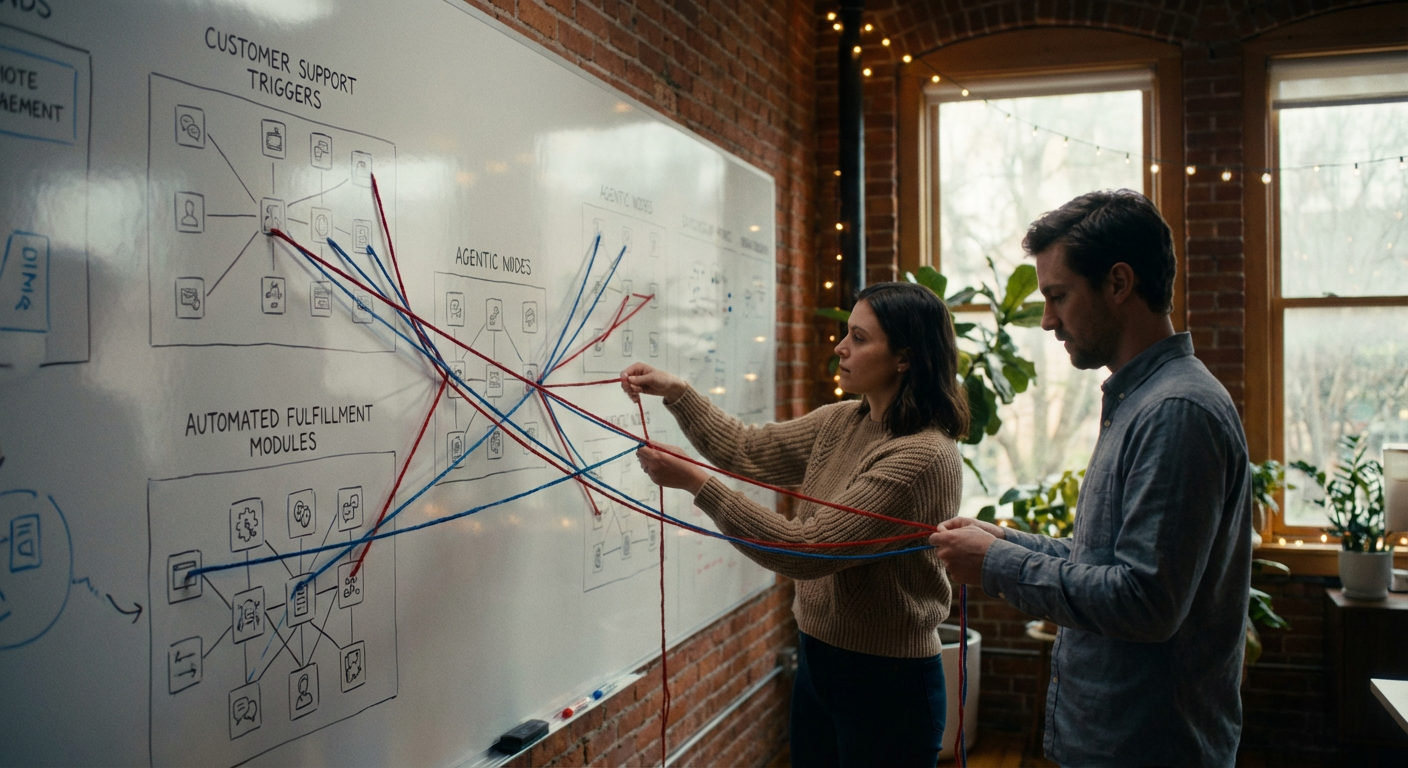
Autonomous B2B Research: Why Agents Are Replcing Lists
Stop buying static lists. Discover how autonomous AI agents are rewriting B2B sales in 2026 by conducting deep, sniper-level research on autopilot.
If you’re still buying static email lists and handing them to a Sales Development Representative (SDR) to "dial for dollars," you are lighting money on fire.
The era of the "spray and pray" sequence is mathematically over. With reply rates for generic cold outreach plummeting below 1% in 2025, the game has shifted not just toward automation, but toward autonomy.
We are witnessing the death of the linear sales funnel and the birth of the Autonomous Research Agent.
For years, "lead generation" meant filtering a database by "Headcount: 50-200" and "Location: Chicago." That isn't research; that's sorting. True research is reading a CEO’s interview transcript to find a specific pain point, cross-referencing it with their hiring patterns on LinkedIn, and determining—without human input—that they are about to buy software in your specific niche.
This is the promise of autonomous B2B lead research. It transforms the sales workflow from a numbers game into a precision strike operation. Here is how agentic lead generation is rewriting the playbook for 2026, and why the "smartest" person on your sales team next year might be an algorithm.
From Automation to Agency: The Evolution of Lead Gen

To understand where we are going, we have to acknowledge why the current model is broken. Traditional marketing automation tools are dumb pipes. They execute "If/Then" logic perfectly, but they cannot think.
- —Automation (2015-2024): If a lead downloads a whitepaper, send Email #1.
- —Autonomy (2025-2026): Analyze why the lead downloaded the whitepaper, check their company's recent quarterly report for keyword alignment, and decide if they should be emailed, and what that email should specifically say.
This shift is defined by the rise of agentic lead generation. Unlike standard bots that follow a script, AI agents possess a degree of reasoning. They can navigate uncertainty. If an agent looks for a prospect's email and can't find it, it doesn't just error out. It might pivot to finding a different point of contact or deduce the email format based on other colleagues at the same firm.
The "Cognitive Labor" Gap
The bottleneck in B2B sales has never been sending emails; it has been the cognitive labor scanning the horizon for opportunities.
As noted in recent texts on AI-Powered B2B Marketing, the competitive advantage is no longer access to data, but the ability to synthesize "dynamic capabilities" from that data. An autonomous researcher doesn't get tired, doesn't possess bias against certain industries, and can read 5,000 news articles in the time it takes a human SDR to grab a coffee.
The Anatomy of an Autonomous Research Workflow

What does this actually look like in practice? Let’s compare a standard sales motion with an autonomous one.
The Old Way (Human-Driven)
- —Trigger: An SDR gets a targeted account list (TAL).
- —Manual Research: The SDR opens 15 tabs—LinkedIn, company website, Crunchbase, Google News.
- —Synthesis: They try to find a "hook" (e.g., "Saw you hired a new VP").
- —Action: They write an email that is 80% template and 20% customization.
- —Result: 45 minutes spent. The prospect ignores it because the "hook" was weak.
The New Way (Agent-Driven)
In a modern setup utilizing tools designed for AI-powered lead generation, the workflow is inverted. The human doesn't start the process; the agent does.
- —Continuous Monitoring: An autonomous agent monitors the entire web for specific "signals" rather than static demographics. It’s looking for events, not just attributes.
- —Context Construction: The agent detects that a target company has just announced a sustainability initiative. It cross-references this with a supply chain disruption mentioned in a trade journal.
- —Reasoning: The agent concludes: “This company is under pressure to green their supply chain but is facing logistics hurdles. They fit our solution perfectly right now.”
- —Drafting & Orchestration: The agent drafts a hyper-relevant message citing the specific sustainability report and the logistics hurdle, then pings the Account Executive (AE) for final approval or sends it autonomously.
- —Result: 0 minutes of human time for research. High probability of engagement because the timing is perfect.
This aligns with findings from Gartner, which highlight that delivering actionable, objective insights is becoming the primary driver of commercial success. The vendors who win in 2026 will be the ones who arrive with a point of view, not just a pitch.
AI Sales Automation 2026: The "Sniper" Approach
As we look toward AI sales automation 2026, the definition of "scale" is changing. In the past, scale meant volume—blasting 10,000 people to get 10 meetings.
In the near future, scale means velocity of context. It means being able to perform deep, "sniper-level" research on 10,000 people simultaneously.
The Three Pillars of Autonomous Research
Top-performing autonomous systems generally rely on three data pillars:
- —Technographic Data: Not just "do they use Salesforce?" but "did they just uninstall a competitor's pixel from their website yesterday?"
- —Intent Data: Moving beyond "visited pricing page" to "hiring for a role that manages the problem we solve."
- —Psychographic/Cultural Data: This is the frontier. Understanding the company's stance on social issues or internal culture. Research on corporate activism in B2B contexts suggests that B2B buyers are increasingly influenced by values alignment. Autonomous agents can scan CSR reports and press releases to align your pitch with their corporate ethos.
Case Study: Hyperlocal Supply Chains
Consider a logistics software company targeting manufacturers. A standard lead list gives you "Manufacturing Companies in Ohio."
An autonomous researcher, however, could apply a framework similar to Hyperlocal Supply Chains case studies. The AI detects a shift in a prospect's sourcing patterns (via import records) indicating a move to local suppliers. It flags this prospect immediately because they are in a transition phase—the "Golden Window" of sales.
This level of granularity is impossible for a human to track across 500 accounts. It is trivial for an AI.
Redefining B2B Productivity Workflows
So, if the AI is doing the research, finding the lead, and writing the email, do we fire the sales team?
Absolutely not. But you do change their job descriptions.
B2B productivity workflows are shifting from "Execution" to "Orchestration." The role of the SDR is quickly vanishing, being replaced by the "AI Ops Manager" or the "Full-Cycle AE."
The New Human Workflow
Instead of spending 6 hours a day prospecting, the 2026 sales professional spends 6 hours a day:
- —Reviewing Agent Logic: Tweaking the parameters of the AI. "Hey, stop targeting companies with recent layoffs," or "Prioritize companies hiring a CFO."
- —High-Stakes Closing: Handling the complex, emotional part of the deal that requires empathy and negotiation.
- —Strategic Relationship Building: Using the data found by the agent like enso.bot to have higher-level conversations earlier in the cycle.
By offloading the research element, humans can focus on "Augmented Intelligence." According to research on Developing AI and Augmented Intelligence, the most effective systems are dynamic—they learn from human feedback. If an agent sends a lead that the human rejects, the system must learn why. This feedback loop is where the productivity gains happen.
How to Implement Autonomous Research (Without Breaking Your Funnel)
You cannot flip a switch and go fully autonomous overnight. Here is a practical roadmap for implementing agentic workflows:
Phase 1: The "Copilot" Phase (Now)
Don't let the AI send emails yet. Use autonomous research tools to enrich your CRM.
- —Action: Set up an agent to monitor your Top 50 dream accounts.
- —Goal: Have the AI ping you on Slack whenever a "buying signal" (e.g., new funding, executive hire, new product launch) occurs.
Phase 2: The "Draft & Approve" Phase (6 Months Out)
Allow the AI to draft the outreach based on its research.
- —Action: The AI detects a lead and writes a personalized email in your drafts folder.
- —Goal: You review, edit, and click send. This trains the model on your tone and preferences.
Phase 3: Fully Autonomous Top-of-Funnel (12-18 Months Out)
The AI handles initial contact and qualification.
- —Action: The AI researches, engages, and has a conversation.
- —Goal: The human only steps in when a meeting is booked.
The Competitive Moat of 2026
The companies that win in 2026 won't be the ones with the biggest databases. They will be the ones with the smartest agents.
When your competitor is still sending generic "Just checking in" emails to a list they bought three months ago, your autonomous agent will be sending a note referencing a podcast interview your prospect gave yesterday, tying it to a financial goal mentioned in their annual report.
That isn't just efficiency. That is relevancy. And in B2B sales, relevancy is the only thing that converts.
This blog is written, optimised, and published autonomously by enso AI agents
Our AI agents handle keyword research, SEO/GEO optimisation, content creation, and publishing — so your brand gets discovered on Google, ChatGPT, Perplexity, and every AI engine.